
Glucagon got a bad reputation for a while. Because it raises blood glucose, researchers working on diabetes compounds tended to treat glucagon receptor activation as something to suppress, not stimulate. Retatrutide does the opposite , and that’s the entire intellectual bet behind its design.
The case for a glucagon receptor agonist in a metabolic compound rests on what glucagon does beyond glucose metabolism. Glucagon receptor activation drives fatty acid oxidation in the liver, increases resting energy expenditure, and stimulates thermogenesis through pathways that are distinct from what GLP-1 and GIP activate. When you pair those effects with GLP-1-mediated appetite suppression and GIP-mediated insulin potentiation, you get a mechanistic combination that none of the approved GLP-1-class drugs can replicate.
Breaking Down Each Receptor Arm
GLP-1 Receptor Agonism: Appetite and Insulin Signaling
Glucagon-like peptide-1 is released from L-cells in the intestinal epithelium in response to food ingestion. GLP-1 receptor activation slows gastric emptying, stimulates glucose-dependent insulin secretion, and reduces appetite through central nervous system signaling at the hypothalamus and brainstem. Semaglutide (Ozempic, Wegovy) and liraglutide (Saxenda) are selective GLP-1 receptor agonists. Retatrutide activates this receptor as part of its broader profile.
The GLP-1 contribution in retatrutide is what drives the satiety and insulin-related effects. Research in GLP1R-expressing cell lines shows that retatrutide’s GLP-1R binding affinity is comparable to native GLP-1, though the compound’s extended half-life (a product of its albumin-binding fatty acid chain) distinguishes its pharmacokinetics considerably.
GIP Receptor Agonism: Amplifying the Insulin Response
Glucose-dependent insulinotropic polypeptide (GIP) is released from K-cells in the duodenum and upper jejunum. GIPR activation potentiates insulin secretion in a glucose-dependent manner , meaning it amplifies the insulin response when glucose is present but doesn’t trigger hypoglycemia when glucose is low. Tirzepatide (Mounjaro) is the first approved dual GLP-1/GIP agonist. The addition of GIPR activation to GLP-1R agonism is part of why tirzepatide outperformed semaglutide in the SURMOUNT trials.
Retatrutide preserves this dual GLP-1/GIP agonist foundation and builds on it. The GIPR component also has emerging research interest in bone metabolism and adipocyte signaling that extends beyond glucose and insulin dynamics.
Glucagon Receptor Agonism: The Distinguishing Feature
And this is where it gets interesting. Glucagon receptor (GCGR) activation is what separates retatrutide from every other compound in this class. GCGR signaling in the liver drives glycogenolysis and gluconeogenesis , both glucose-raising effects that would be counterproductive in isolation for a metabolic disease compound. The Eli Lilly researchers designing retatrutide appear to have operated on the hypothesis that the GLP-1 and GIP components suppress the hyperglycemic effects of glucagon while preserving its catabolic and thermogenic benefits.
The hepatic energy expenditure driven by GCGR activation: increased fatty acid beta-oxidation, reduced hepatic triglyceride accumulation, amplified mitochondrial uncoupling in brown adipose tissue , occurs through pathways that GLP-1 and GIP don’t directly access. This is the mechanistic basis for retatrutide’s observed effects in research that exceed what GLP-1/GIP dual agonism alone can produce.
What the Research Data Shows About the Triple Agonist Profile
The NEJM Phase 2 trial (Jastreboff et al., 2023) is the most cited human-study benchmark. The 12mg weekly dose cohort achieved a mean weight reduction of 17.5% at week 24. That outpaced what the same trial protocol would have predicted for tirzepatide at equivalent time points. Body fat mass reduction was disproportionate to lean mass reduction , suggesting the GCGR component was contributing to preferential fat mobilization.
In rodent pre-clinical work, the triple agonist profile showed more substantial reductions in hepatic lipid content than tirzepatide at equivalent doses. NAFLD (non-alcoholic fatty liver disease) models showed hepatic triglyceride clearance that researchers attributed specifically to the glucagon receptor component.
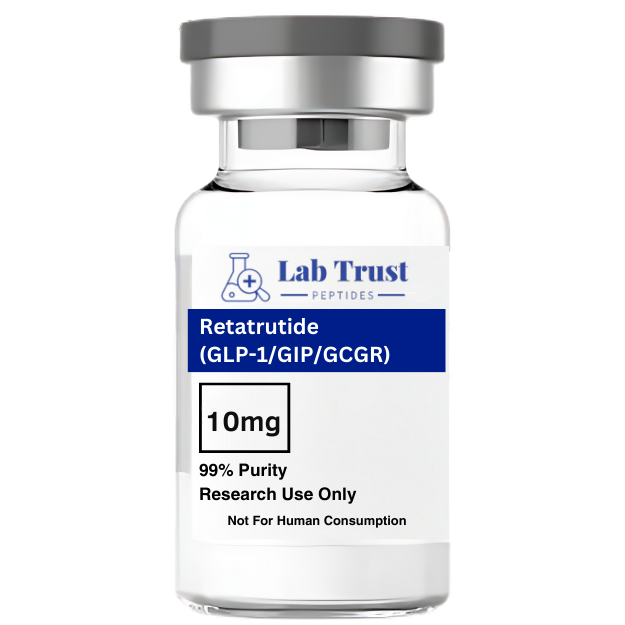
Pre-clinical laboratory work with retatrutide triple agonist glp-1 gip glucagon compounds requires research-grade quality to produce reliable mechanistic data. Receptor binding studies and cell-based assays depend entirely on compound identity and purity being confirmed through independent COA documentation.
How Retatrutide Compares to Other Investigational Compounds
Cagrilintide is a long-acting amylin analog being tested in combination with semaglutide (CagriSema). Amylin receptor agonism reduces food intake through a different central pathway than GLP-1R. The CagriSema combination approaches retatrutide’s magnitude of effect but through a mechanistically different route.
Orforglipron is an oral GLP-1 receptor agonist (small molecule, not peptide) in Phase 3 trials. It offers dosing convenience that injectable peptides don’t, but it’s a GLP-1 selective compound, not a triple agonist.
Retatrutide sits in its own category. No other compound in active development combines all three of GLP-1, GIP, and glucagon receptor activity in a single molecule at the same receptor affinity ratios. That uniqueness is the reason it generates the research interest it does.
Research Benefit Profile: What Labs Are Studying
Labs working with retatrutide as a research tool are typically studying one of four things: integrated receptor signaling models where all three receptors need simultaneous activation; comparative pharmacology benchmarking retatrutide against tirzepatide or semaglutide in the same assay; hepatic lipid metabolism under conditions of GCGR activation; or receptor selectivity and downstream signaling cascade characterization.
The compound’s value as a research tool is distinct from its status as a drug candidate. Even if retatrutide’s clinical development path is modified or delayed, the triple agonist pharmacology model it represents will remain a reference point for how researchers think about combining G protein-coupled receptor activities in metabolic disease contexts.